Motion
RC and push-along vehicles make acceleration, steering, friction, and recovery easy to see. Children do not need abstract vocabulary before they can notice that a lighter touch changes the outcome.
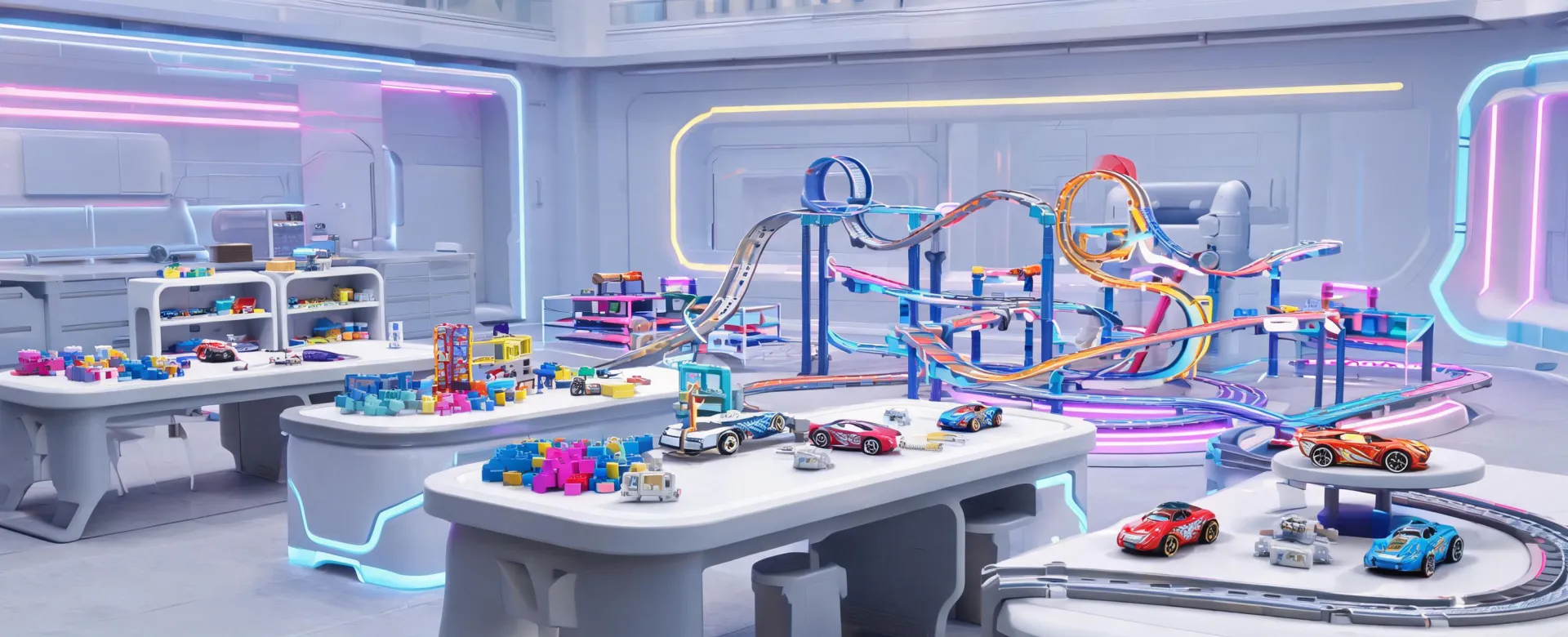
The lab theme is about STEM toy development, not ESG language. Here, every loop, launcher, controller, and building piece is treated as a small experiment children can understand with their hands.
Hot Wheels play becomes more powerful when the child can observe a result, change one variable, and try again. The lab framework keeps that cycle visible.
RC and push-along vehicles make acceleration, steering, friction, and recovery easy to see. Children do not need abstract vocabulary before they can notice that a lighter touch changes the outcome.
Track supports, building blocks, and garage systems invite kids to test stability. A ramp that collapses is not a failed toy moment; it is an opening for redesign.
Sound cues, LED details, checkpoint cards, and visible route changes help children understand cause and effect without needing a screen-first experience.
Collectible vehicles and role-play scenes give technical play a reason to continue. The child is not only testing a course; they are saving a city, winning a rally, or designing a garage.
The table keeps the `specs_table: tech_spec_comparison` structure while translating specs into toy-development decisions parents and buyers can understand.
| Design question | RC & Electric Toys | Building Blocks & Construction |
|---|---|---|
| What does the child control? | Direction, timing, speed mode, recovery, and route choice | Structure, height, sequence, connection strength, and scene layout |
| What feedback is visible? | Vehicle response, turn radius, battery behavior, stunt completion | Fit, balance, collapse points, pathway clearance, replay value |
| What should adults notice? | Secure battery access, age marks, durable shell, supervised speed context | Part sizing, smooth edges, non-toxic finish, rebuild-friendly instructions |
| What content supports launch? | Short challenge videos, controller tips, and route cards | Build prompts, step photos, and "try another design" prompts |
Children learn to guess what will happen before they press, steer, or launch.
They change one track piece or controller move and compare the new result.
Routes, garages, and block systems help them understand shape, fit, and distance.
Grip, alignment, snapping, and steering all build precision through repetition.
Multi-child setups create roles: builder, driver, timer, storyteller, and repair lead.
Clear failures become fixable challenges, which makes trying again feel natural.
Tell us what children can build, steer, test, collect, or retell. We will help translate those actions into a stronger product story.